
Most nurses know what an HSA is, but very few are using it correctly. The health savings account is the only account in the U.S. tax code with three tax benefits at the same time.
- Contributions are deductible.
- Growth is tax-free.
- Withdrawals for qualified medical expenses are tax-free.
And yet, the majority of CRNAs and nurse practitioners treat their HSA like a debit card for copays. The difference between those two approaches is not small. In this episode, we walk through the strategy that separates a $2,000 HSA balance from a $340,000 one. Plus, we’ll cover the mistakes that can cost you thousands on the way out.
You Have to Qualify First: Getting an HDHP
To contribute to an HSA, you must be enrolled in a high-deductible health plan (HDHP). A traditional PPO does not qualify. For 2026, the IRS defines an HDHP as a minimum deductible of $1,650 for individuals or $3,300 for families, with out-of-pocket maximums of $8,300 and $16,600, respectively.
The 2026 contribution limits are $4,400 for self-only coverage and $8,750 for family coverage. If you are 55 or older, you can add another $1,000 on top of that. And if you are a W-2 employee contributing through payroll, your HSA contributions also skip FICA taxes. That’s an extra 7.65% in savings that a 401(k) or Roth contribution does not give you.
The Triple Tax Advantage
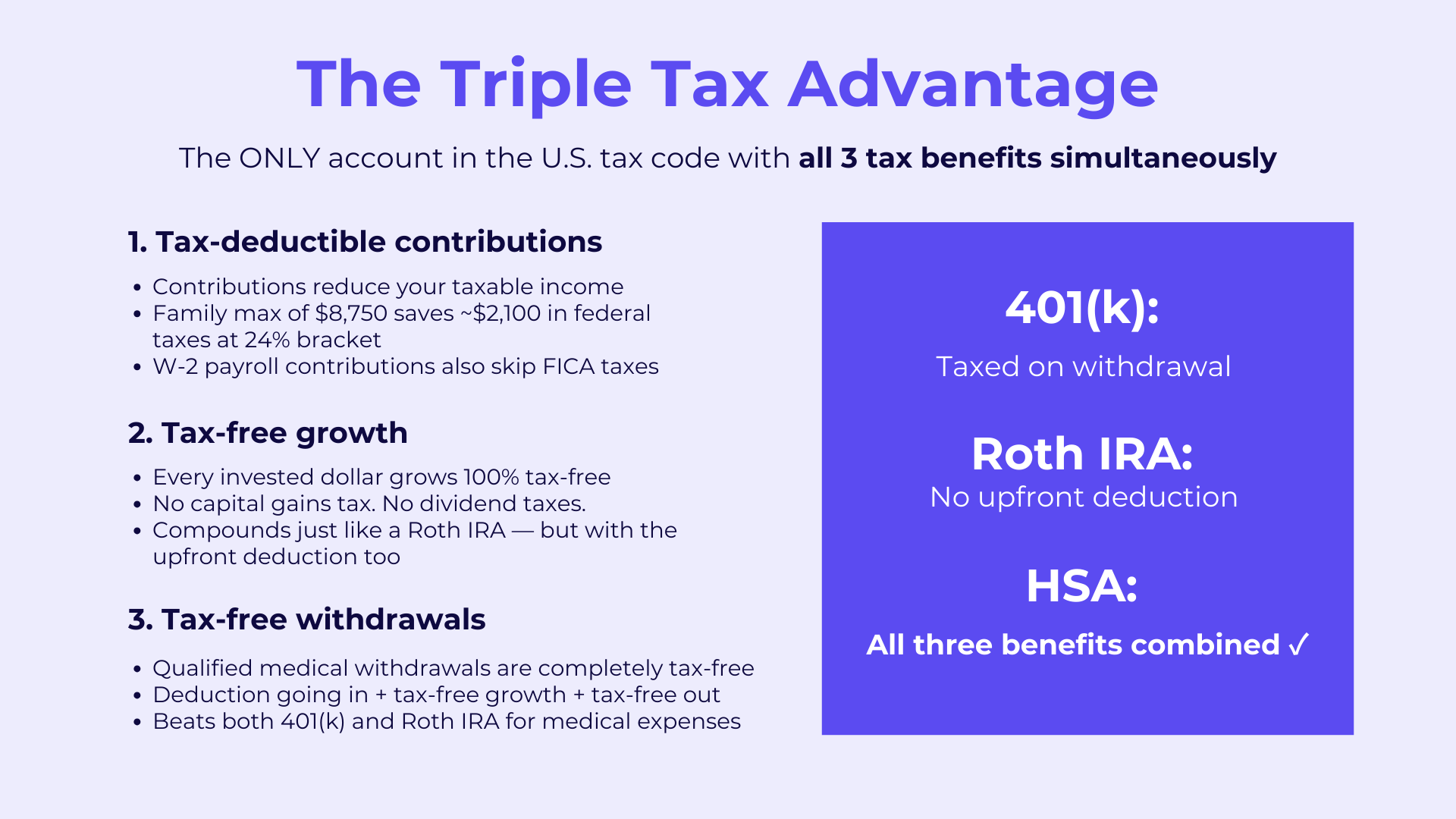
No other account does all three of these at once. Your contributions reduce your taxable income in the year you make them. Every dollar inside the account can be invested, and that growth compounds completely tax-free (no capital gains, no dividend taxes). When you use the money for qualified medical expenses, it comes out tax-free, too.
A traditional 401(k) gives you the deduction going in, but taxes every dollar on the way out. A Roth gives you tax-free growth and withdrawals but no upfront deduction. The HSA beats both of them for medical expenses, and healthcare in retirement costs the average couple over $300,000 over their lifetime.
HSA vs. FSA vs. HRA
These three accounts are not interchangeable. A flexible spending account gives you a tax deduction, but most FSA money expires at year’s end. This is a use it or lose it situation. A health reimbursement arrangement is funded entirely by your employer, and you do not own it. The HSA belongs to you. It rolls over every year, it goes with you from job to job, and there is no deadline to spend it.
The Strategy That Makes the Difference
Meet Lisa and Kevin. Both are CRNAs working at the same hospital, with the same income and the same plan type. Lisa contributes $3,000 a year and pays her medical bills from the account. Kevin contributes the maximum, pays his bills out of pocket, and invests every dollar in the HSA into low-cost index funds.
After 20 years, Lisa has $2,000. Kevin has $340,000.
Most HSA accounts allow you to invest your balance once it crosses a $1,000 to $2,000 threshold. At $8,750 per year with a 7% average return, the math compounds quickly. The account grows to over $340,000 in 30 years, entirely tax-free.
The Shoebox Receipt Strategy
Kevin also does something most nurses have never heard of. When he has a qualified medical expense, he pays it out of pocket and saves the receipt. There is no time limit on when you can reimburse yourself from an HSA. A $3,000 bill paid in 2026 can be reimbursed from the HSA in 2035, tax-free, while the money stays invested in the meantime.
After 12 years of doing this, Kevin has $47,000 in documented receipts. He can pull that amount from his HSA at any time with no taxes and no penalty. The IRS only requires that the expense occurred after the HSA was opened and that it was a qualified medical expense. Keep every receipt.
The Medicare Mistake to Avoid
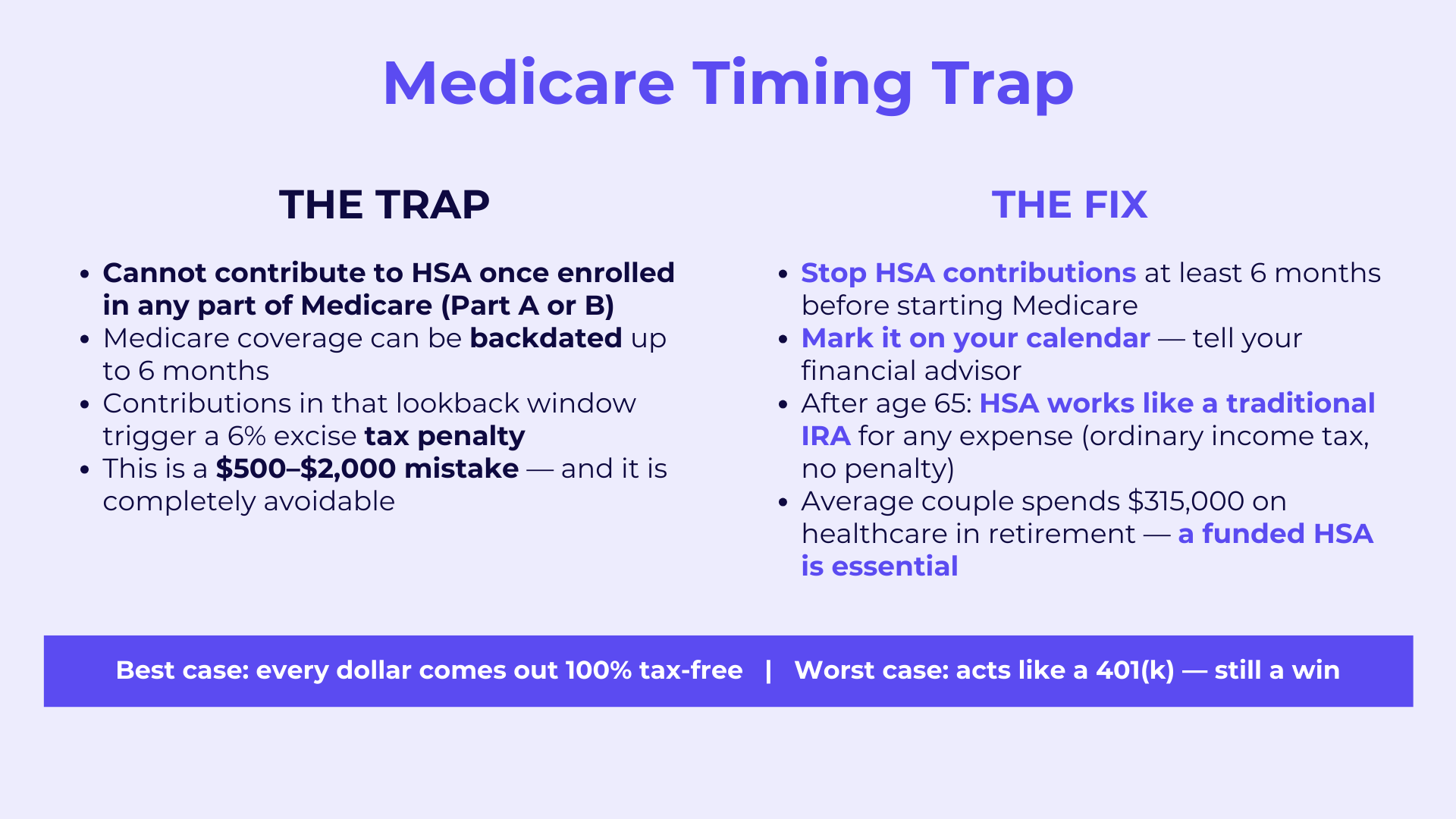
This is the one I see most often as CRNAs approach retirement. You cannot contribute to an HSA once you are enrolled in any part of Medicare. What catches people off guard is the look-back rule: when you enroll in Medicare, your coverage can be backdated up to six months. Contributions made during that window may trigger a 6% excise tax.
The fix is simple. Stop contributing at least six months before your Medicare start date. Tell your advisor. This is a $500 to $2,000 completely avoidable mistake.
After age 65, your HSA works like a traditional IRA for non-medical expenses. You can withdraw for anything, pay ordinary income tax, and owe no penalty. Worst case, it becomes a traditional IRA. Best case, you spend it all on medical costs and every dollar comes out tax-free.
Your HSA Action Plan
Check your benefits portal. If you have access to an HDHP, consider switching at the next open enrollment. Open an HSA, contribute the maximum, invest the balance once you hit the threshold, and save every medical receipt. If you are 55 or older, add the catch-up contribution. The HSA is not complicated. It is just widely underused by the nurses who stand to benefit from it most.
We work specifically with CRNAs and NPs and understand your income, your schedule, and your goals. Ready to see how an HSA fits into your full retirement picture? Schedule a meeting.
Links Relevant to this Episode
Download Your Free Copy of MoneyRx For CRNAs: Secrets and Strategies to Maximize Wealth and Retirement
Looking for more financial planning tips and resources for CRNAs? Check out the MoneyRx for CRNAs Podcast home page for additional podcast episodes.